
HA Solutions for SAP S/4HANA and SAP NetWeaver #
SUSE Linux Enterprise Server for SAP applications is the leading Linux platform for SAP HANA, SAP S/4HANA and SAP NetWeaver. Two of the key components of SLES for SAP are SUSE Linux Enterprise High Availability (SLE HA) and resource agents (RAs). SLE HA provides Pacemaker, an open-source cluster framework. The resource agents manage automated failover of SAP HANA system replication, S/4HANA ASCS/ERS, and NetWeaver ASCS/ERS.
This document provides an overview of the High Availability solutions that SUSE supports for S/4HANA and NetWeaver on SLES for SAP 15 and 16. New solutions will be added when they become available.
Copyright © 2023–2026 SUSE LLC and contributors. All rights reserved.
Permission is granted to copy, distribute and/or modify this document under the terms of the GNU Free Documentation License, Version 1.2 or (at your option) version 1.3; with the Invariant Section being this copyright notice and license. A copy of the license version 1.2 is included in the section entitled “GNU Free Documentation License”.
For SUSE trademarks, see https://www.suse.com/company/legal/. All third-party trademarks are the property of their respective owners. Trademark symbols (®, ™ etc.) denote trademarks of SUSE and its affiliates. Asterisks (*) denote third-party trademarks.
All information found in this book has been compiled with utmost attention to detail. However, this does not guarantee complete accuracy. Neither SUSE LLC, its affiliates, the authors nor the translators shall be held liable for possible errors or the consequences thereof.
1 Support statement #
1.1 Supportability definition #
| Category | Definition |
|---|---|
| Mandatory | De facto, must be implemented this way. |
| Supported | Supported, with a published configuration guide. |
| Supported but undocumented | Supported, but a configuration guide is not published. SUSE will accept bug reports and fix code, if needed. |
| Supported with consulting PoC | Support is possible if the consulting PoC proves to be working. |
| Non-supported | Not supported or not applicable. |
| Planned | On the roadmap to be tested and supported. |
| Legacy | Only supported for older release legacy systems. |
1.2 Infrastructure support #
The infrastructure can be on-premises, physical, virtual or in public cloud. The infrastructure must be supported by both SAP and SUSE Linux Enterprise High Availability so that important functions like fencing and virtual IP are supported.
Public cloud deployment usually needs additional documentation focusing on the cloud-specific implementation details. Check the documentation provided by the respective public cloud vendor.
The support details for SUSE's High Availability solutions for SAP and the support process for each public cloud vendor are defined in the following SAP Notes:
| Company | SAP Note |
|---|---|
| SUSE | SAP Note 1763512: Support details for SUSE Linux Enterprise for SAP Applications - HA Solution for SAP NetWeaver and SAP S/4HANA |
| Microsoft Azure | SAP Note 2513384: SUSE Linux Enterprise Server for SAP applications on Azure |
| AWS | SAP Note 1656099: SAP Applications on AWS: Supported DB/OS and AWS EC2 products |
| Google Cloud | SAP Note 2456432: SAP Applications on Google Cloud: Supported Products and GCP VM types |
For more details, see the SUSE knowledgebase article SLES for SAP - How To Engage SAP and SUSE to address Product Issues.

If necessary, all documented SUSE Linux Enterprise High Availability scenarios can run the SAP workload while the High Availability cluster is temporarily disabled.
1.3 Supported SUSE software versions #
This document applies to SUSE Linux Enterprise Server for SAP applications 16 and 15.
The general SUSE software lifecycle applies for the described scenarios. See the SUSE lifecycle page for details:
https://www.suse.com/lifecycle/#suse-linux-enterprise-server-for-sap-applications-16
https://www.suse.com/lifecycle/#suse-linux-enterprise-server-for-sap-applications-15
SUSE Linux Enterprise Server for SAP applications 12 SP5 is still supported but not covered by this document, as SUSE strongly recommends upgrading to newer OS versions. If you need details about version 12, check the individual guides available at https://documentation.suse.com/sbp/sap-12/.
2 Overview of HA solutions for S/4HANA and NetWeaver #
2.1 Operating system support #
SAP S/4HANA is supported on SLES for SAP 15 and 16. SAP NetWeaver is only supported on SLES for SAP 15.
| OS release | S/4HANA | NetWeaver | Simple Mount file system structure |
|---|---|---|---|
| SLES for SAP 16 | Supported | Non-supported | Mandatory |
| SLES for SAP 15 | Supported | Supported | Supported |
2.2 S/4HANA based on ABAP Platform 1809 or newer #
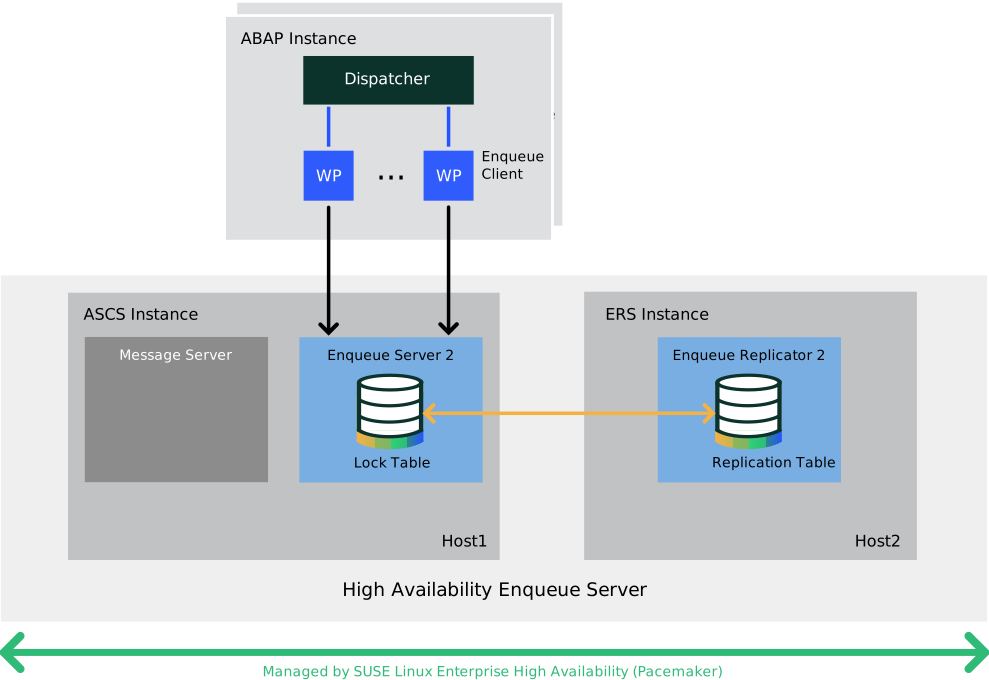
Standalone Enqueue Server 2 (ENSA2) is the successor to Standalone Enqueue Server (ENSA1). Starting from ABAP Platform 1809, Standalone Enqueue Server 2 is the default installation. The use of the new Standalone Enqueue Server 2 and Enqueue Replicator 2 provides an improved High Availability architecture with robust and fast replication and failover.
2.3 NetWeaver based on ABAP Platform 1709 or older #
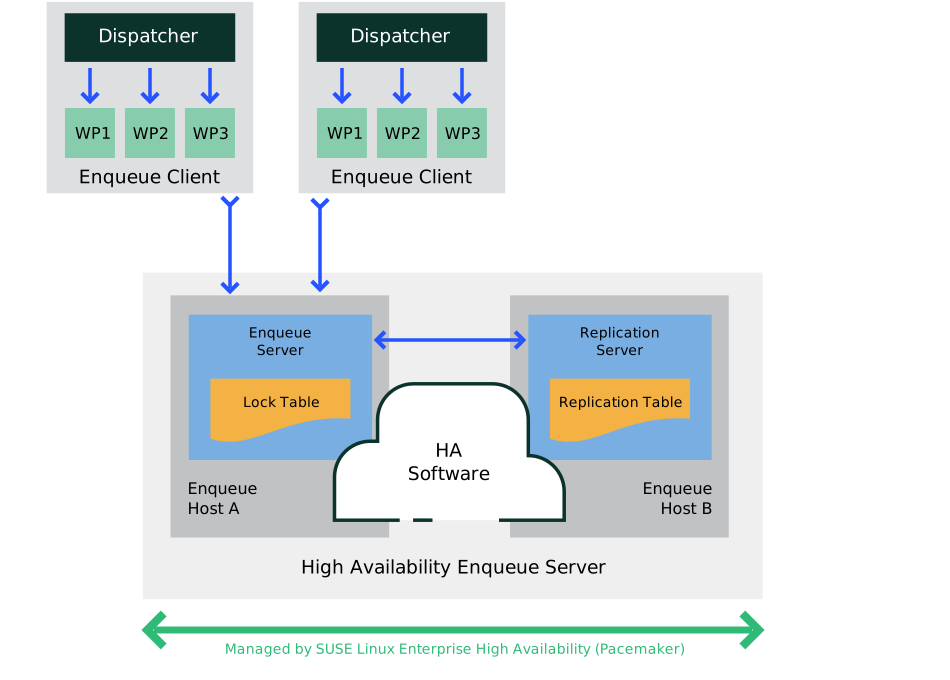
Under the Standalone Enqueue Server (ENSA1), the ASCS has to fail over to the cluster node where the active ERS is running, because it needs to access the shared memory that stores the enqueue replication table.
3 Support matrix for S/4HANA based on ABAP Platform 1809 or newer #
The support details are for a high-level overview only. Refer to the official documentation for the full conditions.
| Supported configuration | Status | Support details |
|---|---|---|
| 2-node cluster | Supported (Documentation) | In a 2-node cluster, ASCS fails over to the same node where ERS is running. |
| 3-node cluster | Supported (Documentation) | In a 3-node cluster, ASCS fails over to the online node where ERS is not running. |
| Simple mount file system structure |
Supported | Shared file system mounts are NOT managed by the cluster. This is the recommended configuration over the Filesystem resource-based solution. |
| Filesystem resource-based | Supported (Documentation) | Shared file system mounts are managed by the cluster via the Filesystem resource agent. SUSE still supports this configuration, but it is not recommended for new installations. Use the simple mount file system structure instead. |
| Multi-SID | Supported (Documentation) | Multiple SAP ASCS/ERS clustered instances are supported in the same cluster. |
| Additional dialog or other instances in cluster | Supported but undocumented | Although it is possible to run Application Servers in the same cluster where ASCS/ERS are running, it is not recommended for easy management of the cluster. |
| SAP Web Dispatcher in cluster | Supported (Documentation for the Filesystem resource-based setup; not yet documented for the simple mount structure) |
This solution combines the following resources into one cluster resource group:
|
4 Support matrix for SAP NetWeaver based on ABAP Platform 1709 or older #
The support details are for a high-level overview only. Refer to the official documentation for the full conditions.
High Availability for SAP NetWeaver is not supported on SLES for SAP 16.
| Supported configuration | Status | Support details |
|---|---|---|
| 2-node cluster | Supported (Documentation) | In a 2-node cluster, ASCS fails over to the same node where ERS is running. |
| 3-node cluster | Supported but undocumented | A 3-node cluster is supported, but the extra node is not used for ASCS failover. |
| ABAP (ASCS) and Java (SCS) | Supported | For details, check https://support.scc.suse.com/s/kb/SUSE-HA-for-SAP-NetWeaver-7-50-Java-central-services |
| Simple mount file system structure | Supported (Documentation) | Shared file system mounts are NOT managed by the cluster. This is the recommended configuration over the Filesystem resource-based solution. |
| Filesystem resource-based | Supported (Documentation) | Shared file system mounts are managed by the cluster via the Filesystem resource agent. SUSE still supports this configuration, but it is not recommended for new installations. Use the simple mount file system structure instead. |
| Multi-SID | Supported (Documentation) | Multiple SAP ASCS/ERS clustered instances are supported in the same cluster. |
| Additional dialog or other instances in cluster | Supported but undocumented | Although it is possible to run Application Servers in the same cluster where ASCS/ERS are running, it is not recommended for easy management of the cluster. |
| SAP Web Dispatcher in cluster | Supported (Documentation for the Filesystem resource-based setup; not yet documented for the simple mount structure) |
This solution combines the following resources into one cluster resource group:
|
5 Documentation and configuration guides #
Refer to the official Web sites for up-to-date documentation and configuration guides:
- SUSE Best Practices
SUSE Best Practices: SAP applications on SUSE Linux 16: https://documentation.suse.com/sbp/sap-16/
SUSE Best Practices: SAP applications on SUSE Linux Enterprise 15: https://documentation.suse.com/sbp/sap-15/
- Public cloud providers
Microsoft Azure: https://azure.microsoft.com/en-us/solutions/sap/#documentation
Google Cloud: https://cloud.google.com/solutions/sap/